The Books of Anguish
There was a boy in Galluccio who couldn't think big.
Not because he was stupid, and not because he lacked the drive. It's that when you live in certain environments, what surrounds you is what defines you.
I could feel there was something more, but I couldn't even imagine what it was.
And that made me suffer. Without really knowing why.
Then I started doing the simplest thing in the world, and at the same time the most underrated.
I started reading.
And I read what I still call, to this day, the books of anguish. Everyone else calls them self-help books.
Why I call them that
Because they're books that make you think in a way you'd never thought before. And while you read them, you understand two things.
The first: that you're very far behind.
The second, which is the truly frightening one: that the things that need to change aren't out there. They're inside you, and they're so deep that you wouldn't even know where to begin.
You close them and you feel worse than before. At least for a while.
One of these is The Power of Your Quantum Brain, by Italo Pentimalli. I reread it these past few days, and inside it lies the answer to a question I asked myself as a kid, and that I think you've asked yourself too.
Why does everything always happen to me?
And its opposite: why does everything always work out for that guy?
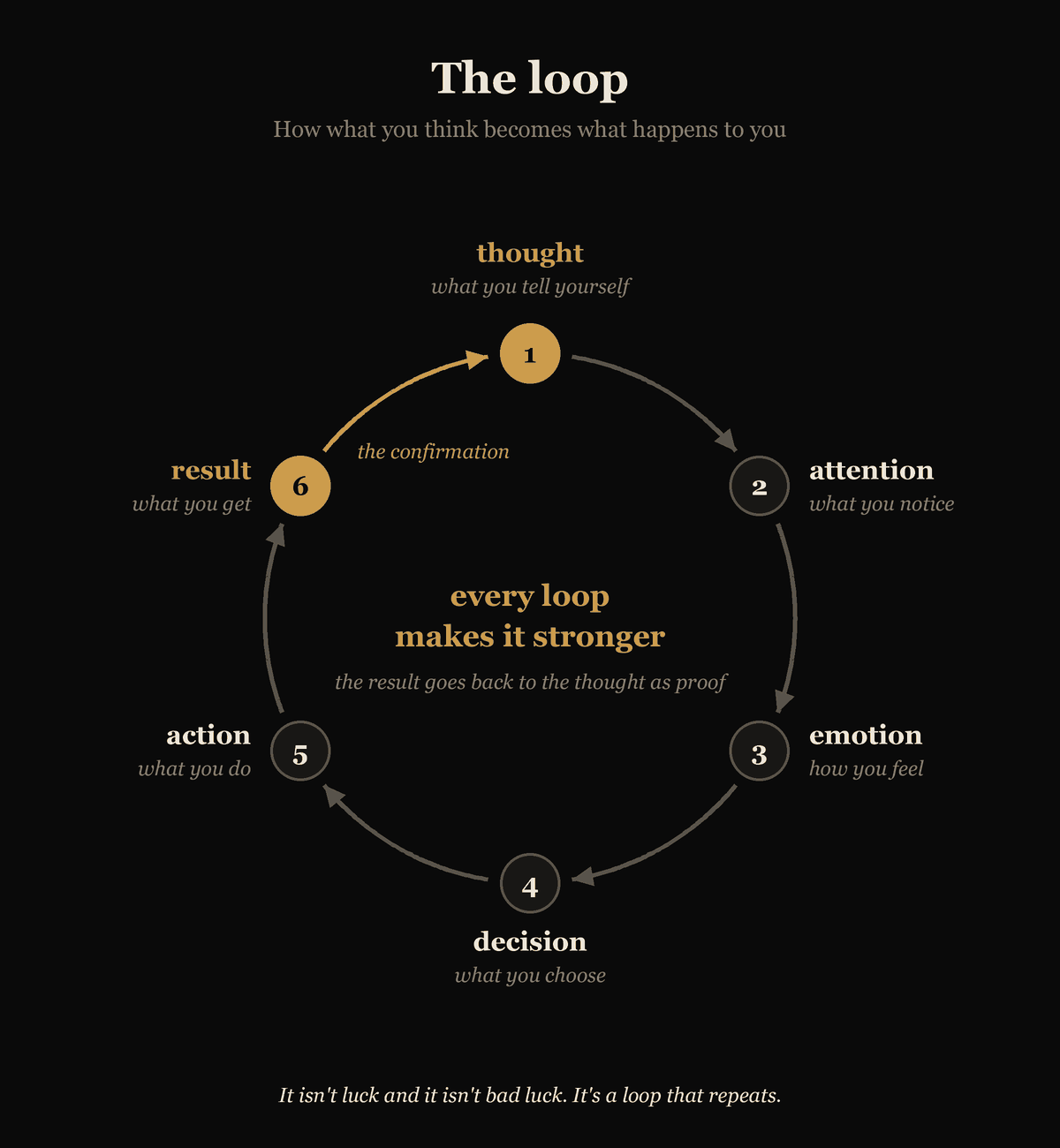
The book's answer is simple, and a little brutal. It's not luck. It's not bad luck. It's a cycle.
The cycle
Here's how it works, and it's the same for everyone.
What you think decides what you notice.
What you notice makes you feel a certain way.
How you feel decides what you choose.
What you choose decides what you do.
What you do produces a result.
The key is that last step: the result doesn't stop there. It feeds back into the thought it started from, and proves it right. It becomes its evidence. And over time, it becomes your way of being.
And so the thought starts again, a little stronger than before.
Now let's take a real day. And brace yourself.
A day when everything goes wrong
And don't feel like you're on trial.
You wake up and the alarm didn't go off. You're late.
The thought. The first thing you tell yourself is: "here we go, today's one of those days."
The attention. From that moment, your mind starts looking for confirmation. It doesn't do it on purpose, it just does it on its own. The traffic. The coffee that spills on your shirt. The email from the complaining client. You notice all of it. The colleague who smiles and waves at you, though, you don't even see him.
It's like when you buy a car and suddenly you see it everywhere on the road. The cars haven't multiplied. What's changed is what you're looking at.
The emotion. Every little thing that goes wrong loads you up a little more. By mid-morning you're irritable, worn out, and you have the feeling that the world is out to get you.
The decision. And when you feel that way, you decide accordingly. You put off the important call, it would go badly today anyway. You snap at the colleague who asks you something.
The action. So you don't make the call. And you get into it with the colleague.
The result. By evening the client is still angry, the important thing is still sitting there, and there's tension with your colleague. You go home and tell yourself: "see? What a shit day. I knew it from the moment I woke up."
And maybe at home your wife, or whoever's close to you, says "you're always the same." And that's when the beast inside you comes out.
There's the circle closing. That result is the proof that the morning's thought was right.
And the most dangerous part is the next day. Because the next day the thought doesn't start from zero. It starts from "and yesterday too." And round after round, "today's one of those days" becomes "everything always goes wrong for me."
Notice one thing: the alarm that didn't go off is the only real piece of bad luck in that entire day. Everything else was built by the cycle.
Why you don't see it
The book calls these things mental programs. And the trouble is, they run on their own.
It's like learning to drive. At first you think about everything: the clutch, the mirror, the gear. After a few years you drive while talking, eating, thinking about other things. You don't think about it anymore, you just do it.
Our thoughts work the same way. After enough rounds, you can't see the cycle anymore. It doesn't feel like a thought, it feels like reality. And nobody questions reality.
With one important difference: you chose to learn how to drive. These programs, on the other hand, came pre-installed.
And the lucky one?
The cycle runs in the other direction too.
The person who seems "lucky" to you often simply has the opposite loop. He thinks things will work out. He sees opportunities. He feels energized. He tries, calls, moves. And sometimes it actually works out. And that time becomes his proof.
Life isn't rewarding him. He just plays more games.
And if his alarm doesn't go off? He sets two, just in case. Or he gets up, and the first thing he does is call ahead to say he'll be late. He doesn't try to fight his emotions, he manages them. He's already late anyway.
Remember the courtroom?
If you missed it, you can find last Sunday's letter here.
Now that you've seen the cycle, I can connect it to that letter.
I told you about the courtroom we carry inside us: the voices, the judge, the verdict we call "how I feel." Well, the cycle is what happens after the verdict. And what, at the same time, creates it.
The verdict doesn't just sit there. It goes looking for evidence for the next trial. And it wins the next trial for certain, because it gathered its own evidence.
The courtroom doesn't just judge. It prepares the next trial.
Now...
The book also has a section on frequencies, vibrations, quantum physics supposedly attracting events. I'll leave that part where it is. Not because it doesn't fascinate me, but because it needs its own letter.
And one thing needs to be said clearly: the cycle doesn't explain everything. Real misfortune exists. Illness, people who take advantage of you, places from which it's genuinely harder to start. Galluccio, for me, was one of those.
But here's the thing, was it a misfortune or my launchpad? Today, when I'm the judge, I can tell you: you choose. You can command the cycle.
Because the cycle decides something enormous: what you see, and what you do with what happens to you. And on that, the pen is yours.
The boy from Galluccio
I think back to that boy now.
He couldn't think big because his cycle had been written entirely there. He only saw what confirmed that the world ended where the village ended. And every time he didn't try, the village proved him right.
The books of anguish didn't give me the solution. They let me see the cycle. And seeing it hurts badly, because you realize that for years you were the one gathering evidence against yourself.
But it's also the only way out. A cycle you can see, you can break. All it takes is one different round, just one: a time when you try even though your mind tells you it'll go wrong. It's not guaranteed to go right. But for the first time, you bring a piece of evidence into the courtroom that the judge wasn't expecting.
So here's this week's question.
What's the phrase you use to explain your bad luck? "Everything always happens to me." "I'm just not cut out for it." "It never works for me."
For one week, look for the evidence that proves it wrong. Write it down, even the small things. And if you'd like, write it to me, just reply to this email.
Not to convince yourself that everything is fine. But to see how many things your judge left out of the courtroom.
Fifty-four attempts to become better. This is the twenty-eighth. Best, Stefano.
If you feel like it, reply to this email and tell me. I read every single one, myself.
Fifty-four attempts to become better.
54letter.com