5427 / 54
The courtroom
What you feel isn't true.
I know, put like that, it sounds cruel. The anger you felt yesterday was absolutely real, you could feel it in your stomach. So was the fear last night. And yet, no.
Not because you made it up. But because what you feel isn't reality. It's a verdict. It's what a courtroom inside your head has decided, one that works all day long without you ever seeing it.
I only truly realized this myself this week.
I came back to Dubai, and like every time I return here, I deleted all my social media. My phone is a phone again: calls, messages, maps. In that silence I go back to studying my old things, things I've already read, trying to understand one more piece of myself.
And in the silence, something happens that you don't notice with all the noise. You hear the voices. The one that accuses you, the one that defends you, the one that reminds you how it went last time. And then the one that doesn't argue: it listens for a second, and decides.
It's a real trial. Except it lasts three seconds, it all happens inside you, and you see nothing. You only see the verdict. And you call the verdict "how I feel."
In the last letter I'd written it almost by accident: "a fake courtroom, where the verdict is written before you even open your mouth." That wasn't just a phrase. It was a precise description of how we work.
Today I'm going to explain it to you. Simply, because it is simple. The hard part is noticing it.
How a law is born
Let me start with something that seems obvious.
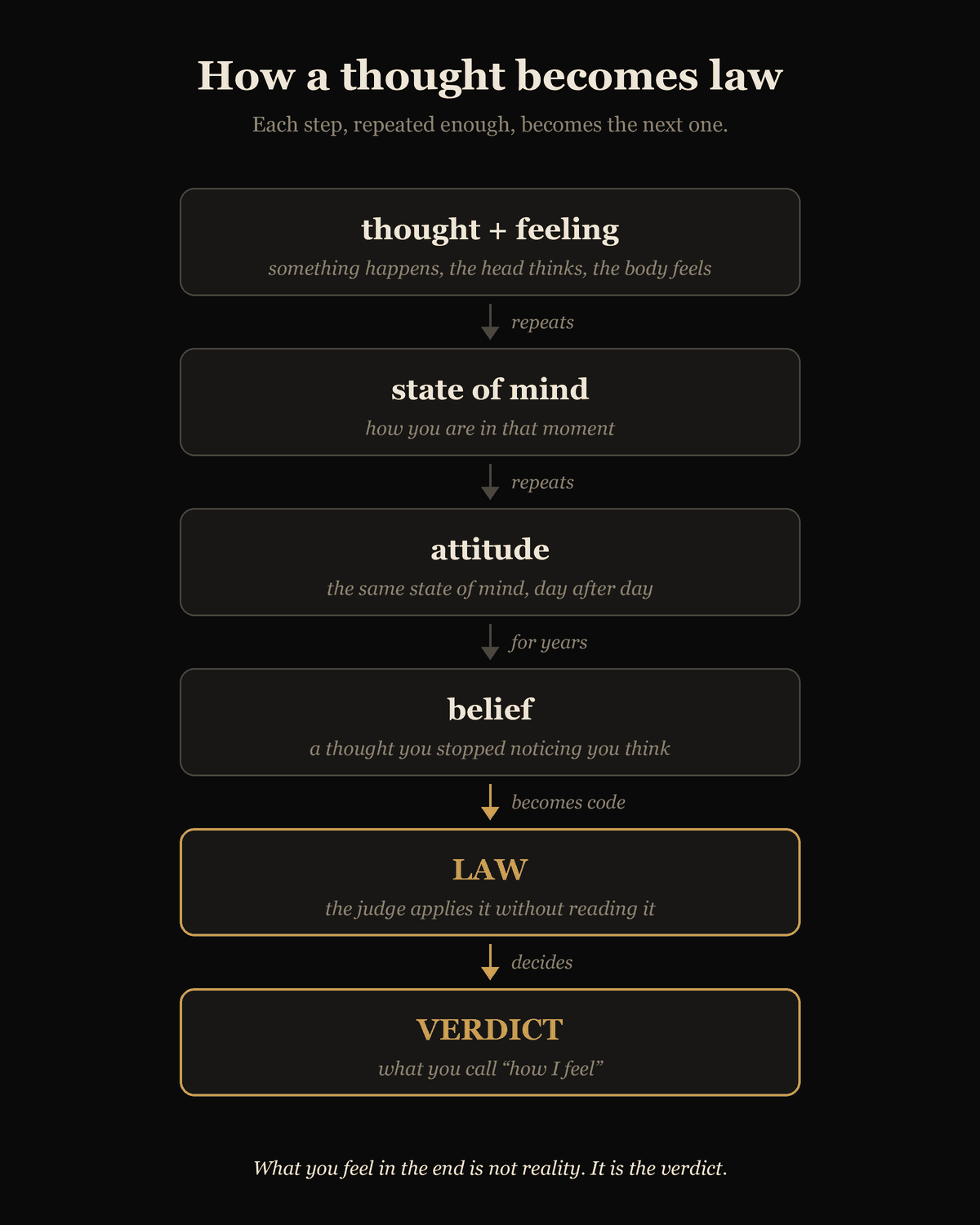
Every time something happens to you, your brain does two things at once. It thinks something, and it makes you feel something. A thought and a sensation. The thought is the language of the mind, the sensation is the language of the body. Together, they form a state of mind.
Nothing surprising so far.
The problem is when that state of mind repeats itself. The same thought, with the same sensation, today, tomorrow, the following month. Through sheer repetition it becomes an attitude. And an attitude repeated for years becomes a belief.
A belief is nothing more than this: a thought you've thought so many times that you've stopped noticing you're thinking it. It no longer seems like a thought. It seems like reality.
And this is where the courtroom is born.
Because a belief, inside you, works exactly like a law. Nobody questions whether it's fair anymore. It's written, it's in effect, it's applied.
"I'm no good with money."
"People will screw you over eventually."
"If I relax, I lose everything."
"As I am, I'm not enough."
None of these sentences were chosen by you. You heard them, you lived them, you repeated them, and one day they went from being sentences to being laws. Without a vote, without debate. They wrote themselves.
Who's in the courtroom
Now let's go inside, and look at who's there.
The witnesses are your memories. And here's the first surprise: memories aren't faithful recordings of what happened. The brain remembers things primarily by how they made you feel. The stronger the emotion, the stronger the memory. That's why you remember word for word the sentence that humiliated you in front of everyone when you were twelve, and you can't remember what you had for lunch on Tuesday. Your witnesses don't recount facts. They recount emotions. And they always recount them in the same voice.
The precedents are your past. "Last time it went like this, so it'll go like this again." Every courtroom relies on precedent, and yours uses them for everything. A new person reminds you of an old one, and the verdict is already ready before they've finished introducing themselves.
The code is your beliefs. Those laws I was telling you about. The judge applies them without reading them, because they know them by heart.
And the judge is habit. It's the part of you that decides on its own, automatically, before you're even aware of it. And it works constantly: most of what you think, feel, and do in a day isn't decided by you. It's decided by the judge, on the basis of that code and those precedents.
Someone's missing, right?
The defense is missing. In the courtroom we carry inside us, almost always, nobody defends the defendant. And the defendant, sometimes, is you. Other times it's someone else. But the trial is always the same: witnesses recounting emotions, old precedents, a code nobody wrote, a judge in a hurry.
The verdict isn't the truth
And here we get to the point that really matters to me.
What you feel, at the end of this process, seems like the truth. You feel offended, so someone offended you. You feel inadequate, so you are inadequate. You feel angry, so someone did something wrong.
But that isn't the truth. It's a verdict. It's a reading of a situation made with the tools you had inside you, tools that were put there by others, long before you could choose. What you think, what you feel, what you experience isn't the world. It's the world as read by your courtroom.
And anger is the clearest example of all.
The way I see it, anger is often simply a failure to understand. It's a verdict issued without a trial. The judge didn't listen to anyone, didn't ask anything, didn't look at the evidence. It saw something that resembled a precedent and brought down the gavel.
Think about it. How many times have you been angry with someone, and then, once you understood what had actually happened, the anger deflated on its own? Not because you calmed down. Because you understood. And once you understood, the verdict no longer held up.
This doesn't mean anger is always wrong. Sometimes you run the full trial, you hear everyone out, you look at all the evidence, and the verdict is the same. That's fine. That's anger that has been through the process, and it has every right to exist.
The problem is all the others. The ones that never went through a trial at all.
Reopening the trial
So what do you do? Do you shut the courtroom down?
No. The courtroom doesn't close. It's useful, it protects you, it helps you decide quickly when you don't have time to think. The problem isn't that it exists. The problem is that it works alone, in the dark, with nobody keeping watch.
There's a sentence that struck me deeply while I was revisiting these ideas. It said, more or less: people try to build a new life with the same personality, and it doesn't work.
It's true. You can change cities, jobs, people, phones. But if the same courtroom is still inside you, with the same code and the same judge, the verdicts will be the same. Just with different scenery.
What you can do is smaller, and harder: slow the judge down.
When you feel a strong sensation rising, anger, shame, fear, before accepting it as true, ask three questions. These are the questions a good lawyer would ask.
What law am I applying? And who wrote it?
What precedent is coming back to me? And does it actually have anything to do with this situation?
Have I understood what happened, or have I just recognized something familiar?
You don't need to answer well. You just need to ask. Because the moment you ask a question, the trial is reopened. And a reopened trial is already a different trial.
Before I let you go
Let me tell you why I delete social media when I'm in Dubai.
It's not a monk's rule, and it's not because social media is evil. It's that when there's a lot of noise, the courtroom works in silence. The verdicts slip through underneath, while you're looking at something else, and you find them on you without knowing where they came from.
When you remove the noise, instead, you can hear the voices. The one that accuses you, the one that justifies you, the one that always has the verdict ready. And a voice you can hear is a voice you can argue with. The ones you can't hear, on the other hand, decide for you.
I do everything I can to grow as a person. And the further I go, the more I'm convinced that growing doesn't mean having more answers. It means processing the ones I already have, better.
So here's this week's question.
Think about the last time you were truly angry. With a person, with a situation, with yourself.
Now reopen the trial. What was the law? Who was the witness? And above all: did you understand, or did you just recognize?
If you understood, the verdict stands. If you only recognized, maybe that person deserves a real trial. And maybe so do you.
Fifty-four attempts to become better. This is the twenty-seventh. Best, Stefano.
If you feel like it, reply to this email and tell me. I read every single one, myself.
Open this letter on the site →
Fifty-four attempts to become better.
54letter.com