Week 20 of 54 — The cave
I didn't want to go anywhere on Ferragosto.
Disconnecting doesn't rest me — it gives me anxiety. August fifteenth, for me, is a Wednesday with more traffic, with obligations to do things for "fun."
And I'd love to see who's actually having fun paying twice the price, waiting twice as long, and being served half as well.
At the last minute, I said yes to three days on a boat in Ponza.
I was with the usual people. The friends you don't have to perform for, don't have to stay sharp for, don't have to be brilliant for, don't have to be anything for. You can go quiet for two hours and nobody thinks something's wrong.
One morning we were up before seven to see a cave. We take the tender, pull up in front of it, leave the tender outside and swim in.
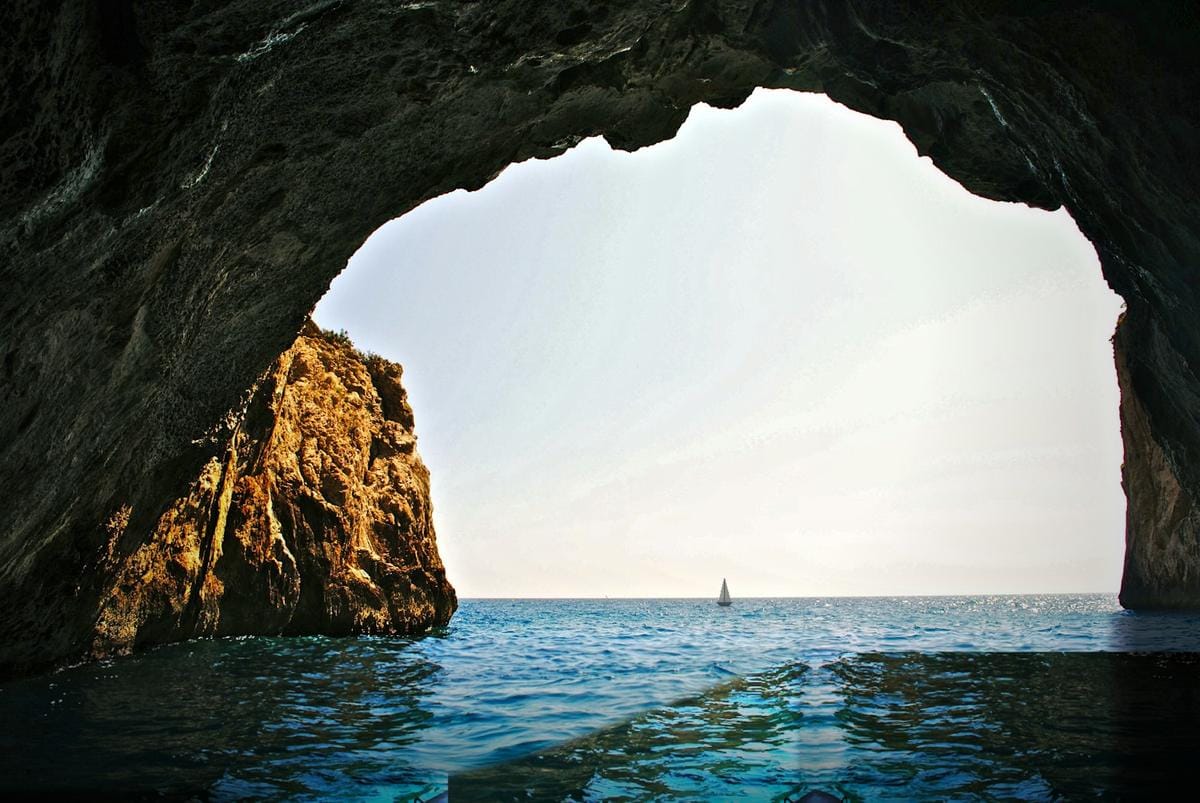
Inside it was dark, cold — that kind of cold the water holds when it's been sheltered from the sun forever. The sound bouncing off the rock and coming back amplified, like the cave was talking to itself. And then, when you reach the little secret beach inside and you turn around, you see a crack. Not big. A hole in the stone.
And through that hole you could see everything.
The sea, the seven o'clock light that's still white, and I swear to you a boat sitting still out there, barely moving.
I didn't have my phone, but I'll recreate the image for you (yes, with AI).
Anyway. While I was floating there in the dark staring at that hole, something hit me.
I'll give you the obvious one first, just to get it out of the way: Plato came to mind. The cave and its prisoners, chained since childhood, a fire behind them. On the wall, the prisoners see only the shadows of objects, and their whole lives they believe the shadows are the world.
Beautiful. But that wasn't my cave.
Because I wasn't chained, and I wasn't looking at shadows.
I was seeing. The real sea, the real light, the real boat. I knew exactly what was out there.
And that's when, instead of feeling relaxed, the philosophical spiral started — all from this one idea: "It's not that we don't know. We know, and we stay."
Because inside you're safe. It's ugly, it's cold, you can barely see — but nothing can happen to you. The sea outside is open. And open means beautiful and open means dangerous.
And the chains, if you look closely, aren't chains.
They're sentences.
The ones we tell ourselves: it's not the right time, I'll sort this thing out first, starting next year, that's just how I am. And the ones other people told us, which are worse, because we don't even remember picking those up: don't bite off more than you can chew, why would you bother, who do you think you are, keep your feet on the ground.
Nobody chained us. They just talked to us. And we sat down.
Now comes the part I actually wanted to write to you about, because last week I left you with a debt. I told you: next time I'll tell you how to find that thing that is you and nobody else.
Here we are.
Because look — "step outside your comfort zone," anyone can say that. But I can also step out and swim in any direction for six hours, in a moment of courage, and end up nowhere, much more exhausted, with the cave now too far away to go back to.
Out isn't a direction. You are the direction.
So the real question isn't "how do I get out." It's who do I need to become to be able to get out.
I've only found one way, and it's not a formula. It's just the only thing that made me stop swimming in circles. It's three things, and all three have to intersect.
What you're good at.
What you enjoy doing.
And how you're built.
The first two are everywhere, and they're not enough: cities are full of brilliant, bored people, and passionate people who never finish anything. It's the third one nobody ever tells you. How you're built: whether you can handle solitude or need people around, whether you need order or chaos, whether risk excites you or wakes you up at four in the morning. Because you can be good at something you even love, and that thing can ask you to be a person you're not. And then you do it well for two years, and something inside you goes dark without you being able to explain it to anyone.
Where those three things intersect, there's a new version to build.
I didn't discover this in a cave on Ferragosto. I'd already written it down. I went looking for it and it's on my phone, buried in the notes I write when I'm not doing well.
▎ We are the mirror image we can't see, but wish we could. The point isn't knowing how to imagine it — it's knowing how to cultivate it, with consistency. […] If what we think, what we say, and what we do were in harmony, we wouldn't even need to exist.
— June 30, 2022
But writing the blueprint isn't leaving the cave: writing the blueprint is something you do comfortably from inside, dry, without even getting your feet wet. I did it for years. I have a collection of maps signed by someone who never moved.
Leaving the cave means taking responsibility for choosing who you want to be, and accepting what everyone denies — that who you are is just a default setting, and your purpose is to dismantle every paradigm and build the personality that fits you best.
And trust me, there is nothing more painful than that.
And here comes the second half, the part I only remembered afterward.
To start understanding how you're built, you need another three things, and they're all inside that June thirtieth note: what you think, what you say, what you do. Aligned.
Because if you think one thing, say another, and do a third, you can have it all perfectly idealized, that new version crystal clear right in front of your eyes — and still stay in that cave for twenty years. You move constantly and don't shift an inch. And the cruelest part is that you even feel like you're moving, because talking about something gives you the same feeling as doing it, for a few hours.
I know something about that. I've left that cave a hundred times — I'm a professional at leaving. Except every time I'd swim up to a boat, and the boat belonged to someone else.
I kept forgetting myself.
And you know, to build the person you want to be, you only have to work on your thoughts.
We're a collection of pieces: what we think, the things we tell ourselves, the people we keep around us. And the thing that's terrifying and beautiful at the same time is that the pieces can be changed. One by one.
Which means whoever comes out of the cave isn't the same person who was inside.
It's not a swim. It's that the swimmer has to change.
And that's why we almost never manage it. Because we're not asking ourselves to cross five meters of cold water. We're asking ourselves to stop being who we've been for thirty years.
Today no questions — I don't have any.
I only know that out there is a world that can't wait to hear your music, and if there's any purpose to this existence I'm certain it's built around making others hear it.
So go. Step out and become who you want to be.
Fifty-four attempts to become better. This is the twentieth. Best, Stefano.
If you feel like it, reply to this email and tell me. I read every single one, myself.
Fifty-four attempts to become better.
54letter.com