54
Week 17 of 54 — The Brainwashing
This week I was in Mykonos. Before that, Barcelona. Celebration days, the kind that destroy your routine, shift your schedule, drag you away from where you'd arrived with such effort. Pleasant, yes. But they threw me off track again.
Then I came home, and had dinner with relatives. One of those dinners where you talk about everything and nothing.
At some point my cousin tells us about her very recent trip to New York. Her eyes light up. She says she'd like to go live there, maybe. And my aunt, with that rough affection of someone who wants to protect you, replies with something I've heard a thousand times in my life: "sure, but someone who comes from a small town has to accept certain things. How are you going to go live in New York?"
And I, without even thinking: "sorry, and what about me then? From Galluccio, a thousand people, how did I end up traveling half the world?"
She looks at me. And she says a sentence that hasn't left my head since:
"Well, you brainwashed yourself."
She said it like an accusation. As if to say, you told yourself a story, you convinced yourself of something that doesn't apply to normal people, you're not one of us anymore.
And I, instead of taking offense, sat there with my fork suspended in midair thinking: that's the truest thing anyone has said to me in years.
Yes. I brainwashed myself. That's exactly what I did.
But there's a part my aunt didn't see, and I want to show it to you.
The point isn't that I brainwashed myself and my cousin didn't. The point is that we both did. She just didn't choose it.
None of us chose the parents we got. No one chose what country to be born in, what school to attend, what phrases to hear repeated at the dinner table for twenty years. "Dreams stay in the drawer." "Be content." "Someone like us can't do certain things." You didn't choose those words — they started drilling them into you when you were too young to defend yourself. And after hearing them over and over, you believed them. They became your own voice.
That is brainwashing. Identical. Except someone else did it to you, without your knowledge, and nobody calls it that because it's the common one, the default one.
So get one uncomfortable thing into your head: there's no such thing as "the clean brain, the real me, just how I am." There's no one who hasn't been programmed by something or someone. There are only two kinds of people. Those who let their brain be washed by others and by chance, forever. And those who at some point pick up the pen and begin, painstakingly, to rewrite it themselves.
The only real choice isn't "to be programmed or not." That one's lost from the start for everyone. The choice is: who holds the pen.
And here comes the hard part, the part that motivational quotes never include. Because "rewrite your brain" sounds wonderful, but it's an agonizingly slow thing, and your own brain rows against you even as you're doing it.
I read this from someone who studies how this machine works. He said that dopamine — what everyone calls the pleasure molecule — is actually the surprise molecule. The brain doesn't reward you for the result: it rewards you for the unexpected. That's why the first two weeks of something new are electrifying, and the sixth, seventh, eighth — the ones where you're actually building the part that matters — feel flat, dead, meaningless. Not because you're doing it wrong. But because the brain has switched off the charge, exactly when the thing was starting to work.
And real growth goes like this: gradually, gradually, gradually. And then all at once. A flat line for a very long time, that at some point spikes upward. Except we can't sustain the flat line. We quit. And, statistically, we quit almost always at the flattest point on the curve — meaning the instant before it spikes.
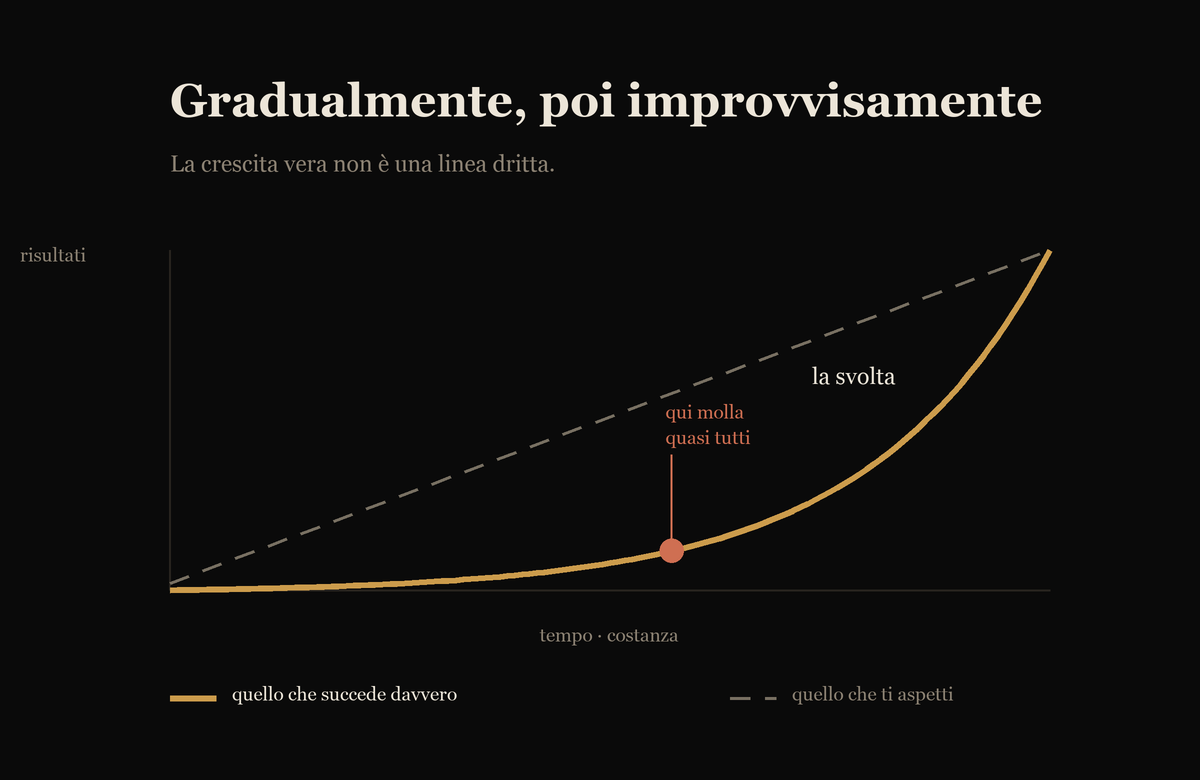
And here, I know, you're expecting me to tell you how to sustain that flat stretch. The trick for not quitting right there. I don't have one. In fact: a trick doesn't exist, and whoever sells you one is just profiting from your impatience. The only thing I found, I had written one night in Bangkok:
▎ But how do you change an unconscious mind built over 28 years? One step at a time. And the first step is to stop wanting everything at once, to stop wanting to change everything together in a snap of the fingers.
— December 3, 2023, Bangkok
Twenty-eight years of things written by others, to be dismantled piece by piece, knowing that for months you'll see nothing happen. It's the least gratifying work in the world. And it's the only one that matters.
But I don't want to sell you the fairy tale of the man who rewrote himself and is now master of himself. Because it's not true, and I'll prove it with the most uncomfortable thing I have in my pocket.
Let me show you the Stefano who writes at night, the one who doesn't need to look good in front of his aunt or in front of you. Years ago I wrote this down:
▎ Always at the mercy of things, when in reality I always create everything myself, because I choose not to choose.
— November 27, 2021
Read it slowly. "I choose not to choose." Me — the one who explains to his aunt over dinner that he's the one who decides about his own life — is the same one who confesses at night that most of the time he puts the pen down. I let the old program come back to write. This week, as it happens, I was in Mykonos letting myself be knocked off the routine I'd built with months of effort. Nobody forced me. I chose not to choose. Again.
Because brainwashing isn't an operation you do once and you're set for life. It's something you have to redo every single day, because the old program doesn't erase itself: it stays there underneath, waiting. And the moment you loosen your grip, the moment Mykonos arrives, it comes back to write in your place, in your eight-year-old handwriting.
And so I arrive at the thing I want to leave you with, the one I've been turning over for days.
My aunt thinks it's a matter of circumstances. Where you come from, what family you have, what chances you happened to get. And circumstances matter — anyone who says otherwise is lying to you.
But it's not circumstances that make you a better person. It's decisions.
Two people from the same thousand-person town, with the same "nos" sewn into them as children — I've talked to you about those nos before — end up in two completely different lives. Not because of luck. Because of a chain of small, daily decisions, almost all made when nobody was watching. The circumstance is only the starting point. The decision is all the rest of the road.
I'd asked myself this too, at night, in four words: "am I free if I choose? But if I don't choose, who is choosing, exactly?"
The trouble is that truly deciding is the most exhausting thing there is. Because deciding isn't the bold sentence you say at dinner. It's holding the pen even in the flat week, even when your brain begs you to quit, even when Mykonos calls. And most of us, myself included, choose not to choose. We leave the pen on the table. We go back to someone else's program. And then we call it fate.
I don't have a clean solution — you know how these letters work. I only have the question my aunt left me without realizing it: the brain you carry around, the one with which you make every decision, every day — who wrote it? Them, or you?
And if you don't like the answer: the pen is still there. The fact that someone else has been holding it for thirty years doesn't mean you can't take it back tonight.
Fifty-four attempts to become better. This is the seventeenth. Best, Stefano.
Thank you, aunt. You meant to tell me I'd lost my way. You reminded me of the only good thing I've ever done.
Fifty-four attempts to become better.
54letter.com