The little boy in front of the window
A post caught my eye these past few days.
It was about Alexandr Wang — the guy Meta brought in through a billion-dollar deal to put him in charge of all their artificial intelligence.
And what was stirring up the comments wasn't the billions. It was how he dresses.
I'm attaching the photo of him on stage, at what was the most important event in Meta's AI history.
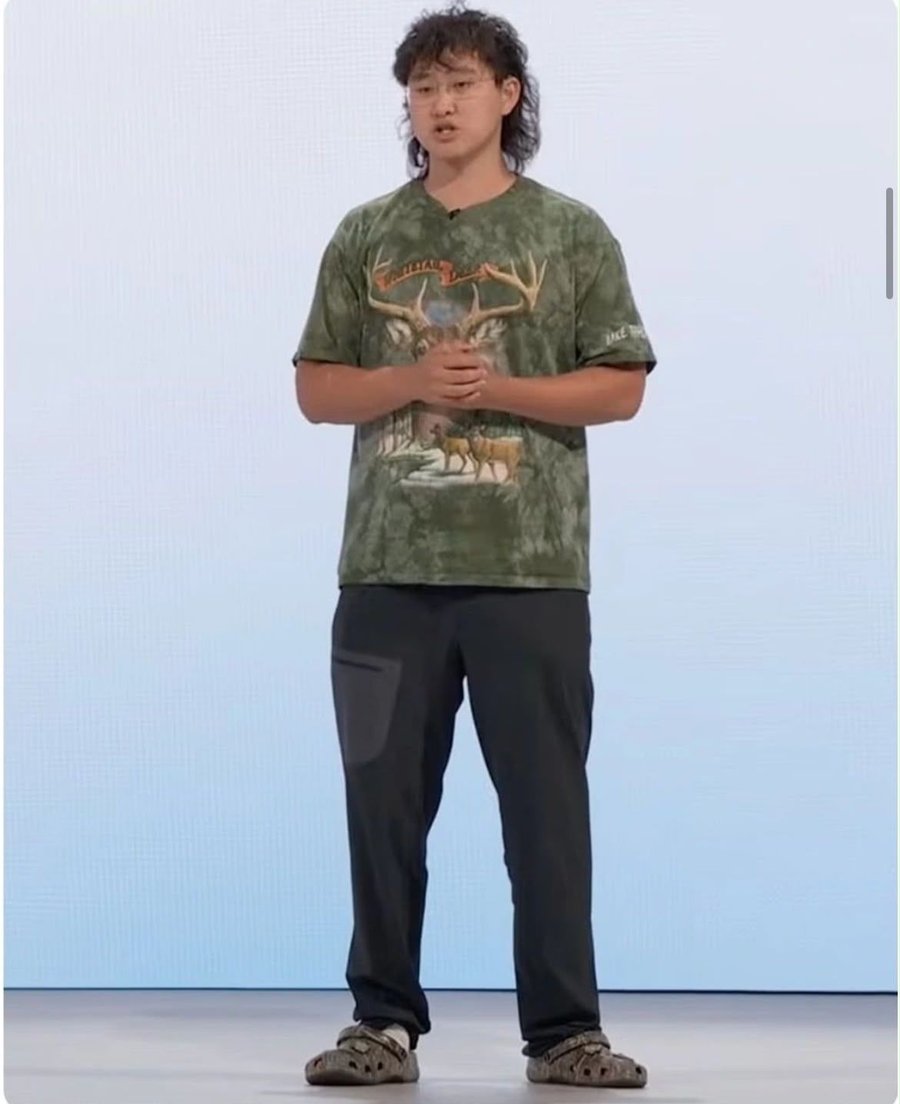
T-shirt, shoes/slides, not even a matching color. No watch, no monogrammed belt. One of the few people in the world who could literally buy anything, and he dresses like the rest of us when we go take out the trash.
Down in the comments, someone had written the line that made me stop: people who buy two-thousand-euro Louis Vuitton do it for the status — he, on the other hand, is his own brand.
And that's when something came back to me from when I was a kid.
The windows
I come from a town of a thousand people, and there was no money at home.
Whenever we happened to go into the city, I'd walk and look at the shop windows. The real ones — the ones in stores I wouldn't even step inside because I already knew. I'd stop in front of the glass and look at the shoes, the jackets, all of it.
And I'd dream. I'd dream about the thousand-euro shoes. I'd dream of wearing Louis Vuitton, Loro Piana, a watch. I'd dream about all of that, with a precision that now almost moves me: I knew the models, I knew the names.
Now I'll ask you the question I never asked myself for twenty years.
Did I actually want it?
Was there a fifteen-year-old in me who loved the design of a shoe, the stitching, the craft behind it? Or did I want it because I'd seen it on someone who seemed to have made it, and in my head it was the proof?
I have the answer, and it's the second one. I never cared about the leather. What I cared about was what that shoe said about the person wearing it.
I wasn't desiring an object. I was desiring to be seen in a certain way.
You need to follow me here, because the point isn't what it seems
I still like that stuff — but squint, cut out the noise, and stay with me.
I'm not telling you fashion is bullshit. There are people who look at a jacket the way I look at something well-crafted in my own work, and they can tell you exactly why that shoulder falls the way it does. Those people are buying something they love, and that's as legitimate as buying a guitar.
The problem isn't the object. It's the reason. And almost no one asks themselves the reason, because it hurts to look it in the face.
So I'll give you a way to find out — and it's brutal in its simplicity.
Think of the last expensive thing you want to buy. Now imagine you can have it, but on one condition: no one will ever see it. You can't post it, no one notices it. It stays between you and it.
Do you still want it?
If the answer is yes, it's truly yours. Buy it, and enjoy it.
If you feel something deflate, then you weren't buying that thing. You were buying the look on other people's faces.
Now let me tell you the cost of all this
Because there is a price — and it's not the one on the tag.
When you buy something to look like someone, you're not making a purchase: you're signing up for a subscription. That version of you needs to be maintained, and it can only be maintained one way — with the next thing. The shoes work while they're new, then they stop. So you need the watch. Then the right place to be seen, then the dinner you pick up the tab for in front of people who need to notice.
And that's where the spiral starts — which is the part no one ever talks about.
Because every time you show something that doesn't truly belong to you, you prove the voice right — the one that says you, just as you are, aren't enough. You don't silence it: you feed it. You're handing it evidence it was right all along, that you couldn't hold up on your own, that you needed external support.
So the distance between what you show and what you are grows wider. And the wider it grows, the more you need to perform to cover it. It never ends, because it can't: you're filling with objects a hole that isn't made of objects.
And all the while, surrounded by all those things, the person furthest from you is you.
That's the real cost. Not the thousand euros. You can make back a thousand euros. The years spent being fake with yourself — those you don't.
And then the money arrives
Then you grow up, and some money comes in. And you discover the most absurd thing of all: that the thousand-euro shoe, once you can afford it, lasts two weeks. Two weeks where you feel like the person you wanted to be at fifteen, standing in front of that window. Then it becomes a shoe. It sits in the closet with the others, and you are exactly the same person as before, a thousand euros lighter and with one more thing to clean — which, if you're being honest, bothers you even when it gets dirty.
The clothes didn't change you. They never do. That's not their job.
And here I know someone will bring up the studies, because they exist and they say the opposite of what I just wrote. It's called enclothed cognition: in one experiment, they had two groups wear the exact same white lab coat. One group was told it was a doctor's coat, the other that it was a painter's. The doctor's coat group performed better on attention tests. Same fabric, different results.
But look at it closely, because it's saying exactly what I'm telling you.
It wasn't the coat. It was what that coat meant to the person wearing it. The clothes make the monk only if you're already a monk.
If you know nothing about monkhood and you dress like a monk, the first person you talk to will see right through you. But if you're already becoming that thing, the clothes push you forward, remind you of who you want to be — and they work.
The outfit amplifies what's already there. It doesn't invent it. And if there's nothing underneath, it amplifies the nothing.
It took me years to understand what I was really looking for — and when I figured it out, I was almost angry at how simple it was.
It wasn't the shoes. It was never an object.
I wanted to feel seen. I wanted to be validated, I wanted to feel like more. And I wanted those things for a specific reason: because I thought poorly of myself. Because deep down I believed I wasn't enough, and I was looking outside for something to tell me otherwise. A shoe doesn't tell you that you're worth something — but for a few days it makes enough noise to drown out the question.
And if the problem was how I saw myself, then the work to be done wasn't about style. It was about my head and what I know how to do. About my abilities, the things I learn, how good I'm becoming at what I do.
There are no shortcuts there, and above all you can't buy any of it. You just do it — one day at a time, without anyone applauding while it happens.
Before I let you go
Back to that guy Meta paid a sum I can't even write down without laughing.
He doesn't dress that way to make a statement. He dresses that way because he doesn't need to: his words and his results already speak. It's not that he doesn't buy things because he's rich — it's that he doesn't need to buy himself proof.
We, on the other hand, buy the proof. Because when you're not sure you're worth something, the expensive object is the shortcut: you put it on and for a moment the question goes quiet.
Except the question was never about the shoe.
That little boy in front of the window wasn't looking at the shoes. He was looking at a version of himself he thought he could buy. And that version wasn't for sale — not there, not anywhere.
It doesn't have a window, that thing. But it's the only thing that stays when you take the shoes off.
So here's this week's question — and take it seriously.
That thing you want to buy: would you still want it if no one could ever see it?
And if the answer makes you uncomfortable, don't throw it away. Hold onto it. Because written inside that discomfort, in plain language, is what you're really trying to prove — and to whom.
Fifty-four attempts to become better. This is the twenty-fifth. Best, Stefano.
PS. He does dress like shit, though. A thousand four hundred words to tell you clothes don't define you, and the very first thing I thought when I looked at that photo was exactly that. It takes a moment to play the wise man, and half a second to go back to being the kid in front of the window.
If you feel like it, reply to this email and tell me. I read every single one, myself.
Fifty-four attempts to become better.
54letter.com