Week 22 of 54 — The Key
Delay is not an obstacle: delay is timing. You just always see that in hindsight, never while it's happening.
I have to confess something that maybe everyone does, or maybe it's just me. I like to think everyone does it, because it makes me feel more normal.
Every now and then I put on a song that fires me up and I picture a scenario. That I'm about to walk onto a stage. That there's a crowd waiting for me. That something big is about to happen, the kind you end up telling stories about. It's hard to explain: it's like I'm bringing into my brain, in advance, the feeling of when something comes together for you.
That feeling, exactly that one, the same feeling I imagine a player must have scoring in the ninetieth minute, flipping the result and the fate of an entire season.
There's no stage. There's only me, lost in it.
This week I was in Mexico City, for work. I was going up to my room after the gym, in the evening, and Spotify had served me Feel This Moment — an old song I would never choose in front of anyone.
I step out of the elevator. Empty hallway, carpet, those low lights that look the same in every hotel in the world. And the song was building. The beats were rising, the thing was growing, and I was walking toward the door imagining the arrival, because the arrival was exactly that: my room.
And the timing was perfect. The big moment, the one where everything drops, was going to land exactly when I opened the door.
I arrive. I put in the key.
It doesn't work.
I try again. Doesn't work. A third time, turning it more slowly, as if the problem were gentleness. Nothing. A fourth.
And meanwhile the song was running, and in my head something precise had already happened: there it is, I've missed the moment. Not "the key isn't working." Literally: I've missed the moment. As if there were an appointment and I'd shown up four seconds late.
Like the perfect cross, the leg stretching out to score, and the awareness of falling just short and missing the shot.
Then the key turned.
It turned right there. On the best beat in the whole song. The door opened inside the track, and I started dancing alone in a hotel room in Mexico City, gym bag still in hand.
(If you're thinking this is ridiculous: yes. A grown man celebrating alone over a door that opens. But if you're laughing, you're also laughing at what I was about to do a second earlier, which was walk into that room already convinced I'd failed at something that didn't exist.)
When the music faded, and the goal had been scored exactly the way I wanted, in the shower I started thinking.
If the key had worked on the first try, I would have gone in too early.
The track would have dropped with me already inside, setting down my bag. It would have been nothing. Those four failed attempts weren't the obstacle between me and the moment: they were what made the moment land at the right point.
And what stopped me there wasn't the coincidence. Coincidences don't interest me. It's that my brain, while it was happening, had already reached a conclusion. Had already delivered the verdict: lost, wrong, too late.
It was wrong, and it had no idea.
So this question came to me. How do we actually live inside time?
We treat time as if there were only one kind, the same for everyone. As if there were a big clock hanging in the middle of the world, and everyone looking at that same one.
By thirty you should have. By now you should already. That person got there first. I'm behind.
But that clock doesn't exist. Everyone is walking down their own hallway, with their own song in their ears, and the big moment falls at a different second for each of them. There's no right moment: there's your moment, calibrated to your track and no one else's.
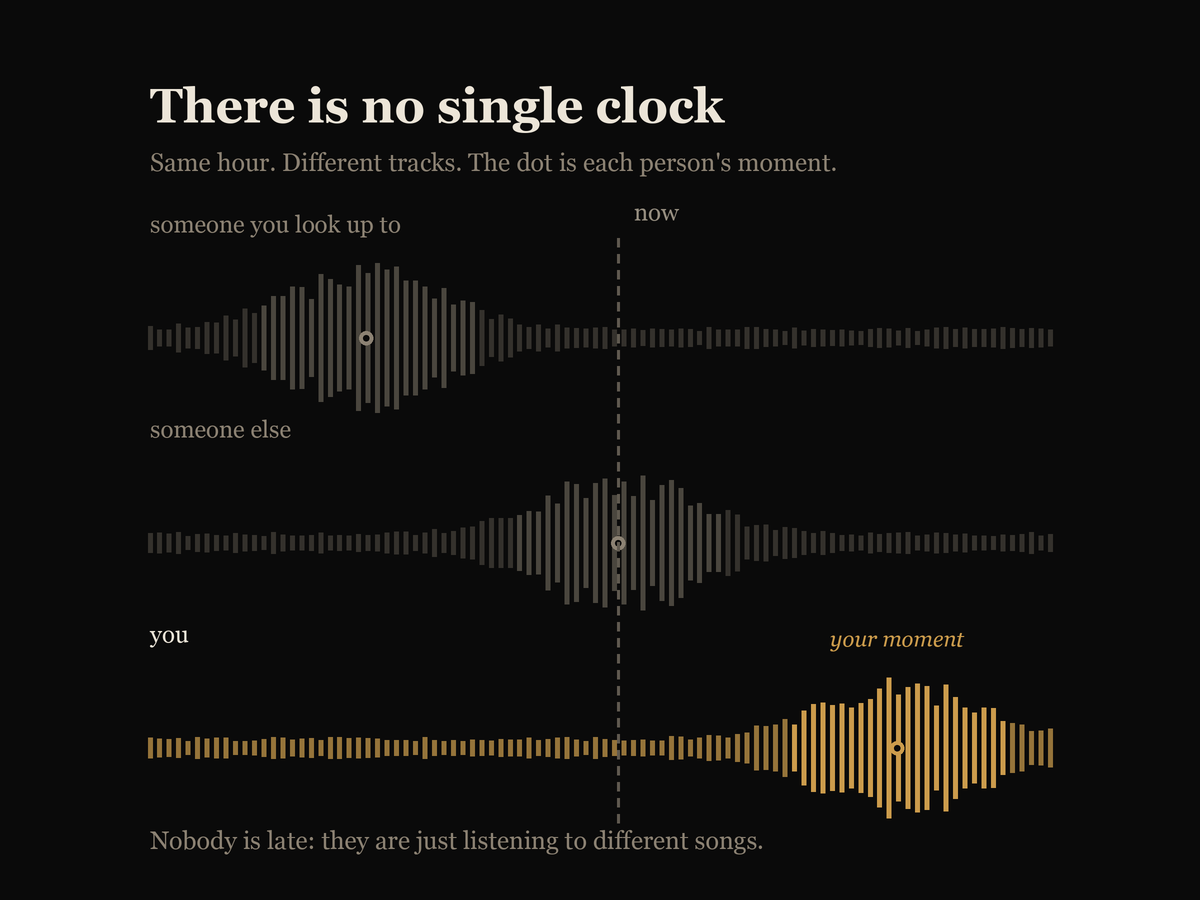
The problem isn't being late. The problem is being late on someone else's music. That's where almost everything that makes us feel bad comes from: not from where we are, but from where we are relative to someone who's listening to a song we can't even hear.
And there's something worse, which is the honest part. While you're standing there with the key in your hand, you can't know whether you're stuck or whether you're just early. The two things look so alike they're identical. You find out later, always later, and sometimes you don't find out at all.
I've been carrying this business about time with me for years, and I have proof that it's not something I've figured out.
▎ I always feel an hourglass about to run out. It makes me feel alone.
— May 24, 2024
That's me, two years ago. And look at the second sentence, the one that matters: it doesn't say I'm afraid of running out of time. It says it makes me feel alone.
Because the flip side of everything I've written above is also true. If everyone has their own track, then no one hears it with you. Running your own race isn't just freeing: it's also running it alone. That hallway was empty for a reason.
And the fight is yours: no one is going to turn the key for you.
Before I let you go
Be careful here, though, because this is where it's easy to fool yourself — and I'm the first to do it. Not every delay is timing. Some keys don't turn because it's the wrong door, and there are people who spend years turning the same key telling themselves the moment is coming. The difference between the two isn't visible while it's happening, and anyone who tells you otherwise is selling you something.
So I'm not telling you everything happens for a reason. I'm telling you something smaller and more useful: the voice that calls the game over while the song is still playing is often wrong. Mine was. Four times in ten seconds.
No question today, but I want you to make yourself a promise.
Write on a piece of paper what you want to happen by December 31st. Then we'll come back to it that day.
Fifty-four attempts to become better. This is the twenty-second. Best, Stefano.
If you feel like it, reply to this email and tell me. I read every single one, myself.
Fifty-four attempts to become better.
54letter.com